top of page
LANZAMIENTO-EN-iNGLÉS_V44.png

COVID-19 AND (IM)MOBILITY IN THE AMERICAS

This is an (un)finished project – therefore under construction– that collectively reflects on (in)mobility and control in the Americas during the pandemic. We sought to map three main themes: 1- state measures; 2- risk situations the migrant population currently face, particularly internally displaced persons, deportees, detainees, asylum seekers, refugees, irregularized migrants, whether they are adults or children or adolescents; and, 3- the social and collective responses in each of the national spaces. By invoking "mapping," we are not by any means intending to produce a fixed map of the continent, or geo-referenced information. In the context of this project, mapping has different meanings. On the one hand, our task has involved gathering press information, systematizing it, and creating a public digital archive about the tension between (in)mobility and control in the vast majority of countries on the continent during the initial moment of the pandemic. On the other hand, inspired by critical cartography, mapping has here implied “deconstructing the map” (Harley, 1989) of the Americas,  in an effort “to read between the lines of the map –in the margins of the text – and through its trope to discover the silences and contradictions that challenge the apparent honesty of image” (1989:3). Mapping has signify brought to light the hidden spaces or conflicts that rests upon (in)mobility and control during the pandemic which deliberately remain outside of a traditional map and thus often outside of public discussion. 

GENERAL

OVERVIEW

mundo.png

COMMON SITUATIONS

refugee.png
sit1.png

Countries where it occurs

sit1.png
sit1.png
sit1.png
sit1.png
sit1.png
sit1.png
sit1.png
sit1.png
sit1.png
sit1.png
sit1.png
sit1.png
sit1.png
sit1.png
sit1.png
sit1.png
sit1.png
sit1.png
sit1.png

National borders across the Americas have been closed in an effort to preserve public health measures and prevent the spread of Covid-19. Despite the existence of cross-border populations and zones of forced displacement, migratory controls have intensified and borders have been militarized. If free mobility was an ideal, today it seems to be a national menace.

Border Closure and Hyper-Surveillance
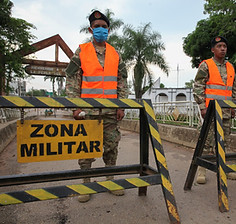
7._Militares_peruanos_guardam_entrada_no

SOCIAL RESPONSES

SITUATION BY COUNTRY 

LÍNEA DE TIEMPO

LÍNEA DE TIEMPO MÉXICO

WATCH OUR EVENTS

To see more visit our YouTube channel

In mid-March 2020, nearly every country on the continent declared a health emergency. These countries closed their borders and adopted a series of exceptional measures, arguing that forced immobility as a  solution to contain the virus. Following the shutdown of borders,  more than 30 researchers from the Americas, interested in analyzing the migratory question politically, organized virtually and began to consider the particular situation of millions of migrants, women, men, children and adolescents, from the continent and/or from other latitudes, all of whom are mobile and in transit.

Original Concept: Soledad Álvarez Velasco, University of Houston

General Coordination:Soledad Álvarez Velasco, University of Houston & Ulla D. Berg, Rutgers University

Research, Systematization and Development of Contents: Soledad Álvarez Velasco, University of Houston;  Ulla D. Berg, Rutgers University; Lucía Pérez-Martínez, FLACSO-Ecuador; Mónica Salmon, New School for Social Research; Sebastián León,  Rutgers University.

Coordination polyphonic map: Iréri Ceja Cárdenas: Museo Nacional/ Universidad Federal de Rio de Janeiro

Project Advisor: Nicholas De Genova, Universidad of Houston.

Translation team Spanish - English: 

Ryan Pinchot, Soledad Álvarez Velasco, Mónica Salmón, Ulla Berg, Luin Goldring, Tanya Basok, Ingrid Carlson, Gabrielle Cabrera, Ryan Pinchot.

Translation team Spanish - Portuguese: 

Iréri Ceja, Gustavo Dias, Gislene Santos, Elisa Colares, Handerson Joseph, Caio Fernandes, María Villarreal.

Website Design and Development:  Daniela Hurtado; Francisco Hurtado Caicedo, Social Observatory of Ecuador

Photography: David Gustafsson y Cynthia Briones.

Video: David Gustafsson.

Some of the researchers of this project are members of these CLACSO Working Groups

English translation and proofreading by Gabrielle Cabrera, Rutgers University.

Suscribe to get updates

Thanks.

Logo-GT-Sur-Sur-CLACSO.png
Fronteras OK-blanco.png

Design:

logoachu.png
bottom of page